
Socialism in the City: When Government Tries to Play God
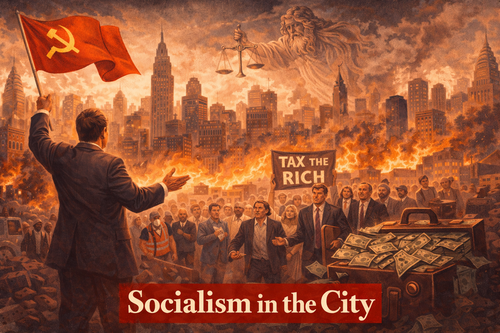
By Dr. Eric M. Wallace
There once was a tv show entitled "Sex and the City," which for some, captured the imagination of urban America: ambition, opportunity, and the promise of flourishing life in our nation’s great cities. Today, a different story is unfolding. A more fitting title for our cultural moment would be “Socialism in the City.”
From Chicago to New York City, from Seattle to Los Angeles and San Francisco, a governing philosophy rooted in collectivism is reshaping public policy. Its advocates promise “equity” and economic justice. But increasingly, the results tell a different story, one of business flight, rising fiscal strain, public disorder, and declining confidence in the very institutions meant to sustain civic life.
This is not merely a policy debate. It is, at its core, a worldview conflict.
A biblical worldview affirms that God, not government, is the ultimate source of provision, justice, and order. When civil authority attempts to assume that role, it inevitably distorts both justice and human responsibility. The result is not restoration, but confusion.
Scripture speaks directly to the moral foundations that undergird a healthy society. The Eighth Commandment declares, “You shall not steal” (Exodus 20:15, ESV). The Tenth Commandment warns, “You shall not covet… anything that is your neighbor’s” (Exodus 20:17, ESV). These commands do more than regulate personal conduct, they establish the moral boundaries necessary for economic and social stability.
Yet many of today’s policy trends in major cities blur, or outright cross, those boundaries.
Under the banner of “taxing the rich,” policymakers increasingly pursue aggressive redistributive policies that go beyond funding legitimate public goods and instead function as instruments of compelled equity. When taxation becomes untethered from its proper purpose and is driven instead by envy or grievance, it ceases to be just and begins to resemble legalized taking.
At the same time, heavy regulation and rising costs are pushing businesses and taxpayers to reconsider their place in these urban centers. Over the past decade, states such as California, Illinois, and New York have experienced measurable net outmigration, including among higher-income earners and employers. Major companies have relocated headquarters or expanded operations elsewhere, citing tax burdens, regulatory environments, and public safety concerns as key factors.
The economic consequences are not theoretical. They are already unfolding.
We have seen this pattern before.
Detroit once stood as a crown jewel of American industry. Its decline was not caused by a single policy, but by a convergence of decisions that undermined economic vitality, discouraged investment, and strained public resources. The lesson is not that cities cannot recover, Detroit itself has made notable strides, but that policies matter, and prolonged misalignment between economic reality and political ideology carries a cost.
Today, many urban leaders appear poised to repeat similar mistakes.
The modern collectivist impulse rests on a flawed premise: that government can engineer equality of outcome without diminishing the incentives, freedoms, and responsibilities that produce prosperity in the first place. But when success is penalized, risk-taking declines. When dependency is subsidized, self-sufficiency erodes. And when government expands beyond its proper role, it crowds out the very institutions—family, church, and community—that sustain moral and social order.
This is why the language of “equity,” though often well-intentioned, can become dangerous when divorced from truth. Equity, in its contemporary usage, frequently prioritizes equal outcomes over equal opportunity, redistributing resources without addressing the deeper causes of poverty and inequality.
A biblical framework calls us to something higher.
It affirms both compassion and responsibility. It calls for care for the poor, but not at the expense of truth, justice, or moral order. It recognizes that human flourishing is not merely the result of policy, but of character, culture, and conviction.
This is where the current trajectory of “Socialism in the City” ultimately fails. It seeks to solve material problems through structural force while neglecting the spiritual and moral realities that underlie them.
History and Scripture warn us where this leads.
In Genesis 11, humanity sought to build a unified system apart from God, elevating its own authority and attempting to secure its own future. The result was confusion and fragmentation. That pattern has repeated itself throughout history whenever human systems attempt to replace divine authority with centralized control.
The answer is not indifference to poverty or injustice. It is a return to principles that align with both economic reality and biblical truth.
This is where a framework like R.I.S.E. becomes essential:
If America’s great cities are to thrive again, they must recover a vision of human flourishing rooted not in centralized control, but in ordered liberty under God. They must reject the illusion that government can replace moral formation, personal responsibility, and the sustaining power of truth.
Because when government attempts to play God, it does not create heaven on earth.
It creates a system that cannot sustain itself—and a society that ultimately pays the price.
There once was a tv show entitled "Sex and the City," which for some, captured the imagination of urban America: ambition, opportunity, and the promise of flourishing life in our nation’s great cities. Today, a different story is unfolding. A more fitting title for our cultural moment would be “Socialism in the City.”
From Chicago to New York City, from Seattle to Los Angeles and San Francisco, a governing philosophy rooted in collectivism is reshaping public policy. Its advocates promise “equity” and economic justice. But increasingly, the results tell a different story, one of business flight, rising fiscal strain, public disorder, and declining confidence in the very institutions meant to sustain civic life.
This is not merely a policy debate. It is, at its core, a worldview conflict.
A biblical worldview affirms that God, not government, is the ultimate source of provision, justice, and order. When civil authority attempts to assume that role, it inevitably distorts both justice and human responsibility. The result is not restoration, but confusion.
Scripture speaks directly to the moral foundations that undergird a healthy society. The Eighth Commandment declares, “You shall not steal” (Exodus 20:15, ESV). The Tenth Commandment warns, “You shall not covet… anything that is your neighbor’s” (Exodus 20:17, ESV). These commands do more than regulate personal conduct, they establish the moral boundaries necessary for economic and social stability.
Yet many of today’s policy trends in major cities blur, or outright cross, those boundaries.
Under the banner of “taxing the rich,” policymakers increasingly pursue aggressive redistributive policies that go beyond funding legitimate public goods and instead function as instruments of compelled equity. When taxation becomes untethered from its proper purpose and is driven instead by envy or grievance, it ceases to be just and begins to resemble legalized taking.
At the same time, heavy regulation and rising costs are pushing businesses and taxpayers to reconsider their place in these urban centers. Over the past decade, states such as California, Illinois, and New York have experienced measurable net outmigration, including among higher-income earners and employers. Major companies have relocated headquarters or expanded operations elsewhere, citing tax burdens, regulatory environments, and public safety concerns as key factors.
The economic consequences are not theoretical. They are already unfolding.
We have seen this pattern before.
Detroit once stood as a crown jewel of American industry. Its decline was not caused by a single policy, but by a convergence of decisions that undermined economic vitality, discouraged investment, and strained public resources. The lesson is not that cities cannot recover, Detroit itself has made notable strides, but that policies matter, and prolonged misalignment between economic reality and political ideology carries a cost.
Today, many urban leaders appear poised to repeat similar mistakes.
The modern collectivist impulse rests on a flawed premise: that government can engineer equality of outcome without diminishing the incentives, freedoms, and responsibilities that produce prosperity in the first place. But when success is penalized, risk-taking declines. When dependency is subsidized, self-sufficiency erodes. And when government expands beyond its proper role, it crowds out the very institutions—family, church, and community—that sustain moral and social order.
This is why the language of “equity,” though often well-intentioned, can become dangerous when divorced from truth. Equity, in its contemporary usage, frequently prioritizes equal outcomes over equal opportunity, redistributing resources without addressing the deeper causes of poverty and inequality.
A biblical framework calls us to something higher.
It affirms both compassion and responsibility. It calls for care for the poor, but not at the expense of truth, justice, or moral order. It recognizes that human flourishing is not merely the result of policy, but of character, culture, and conviction.
This is where the current trajectory of “Socialism in the City” ultimately fails. It seeks to solve material problems through structural force while neglecting the spiritual and moral realities that underlie them.
History and Scripture warn us where this leads.
In Genesis 11, humanity sought to build a unified system apart from God, elevating its own authority and attempting to secure its own future. The result was confusion and fragmentation. That pattern has repeated itself throughout history whenever human systems attempt to replace divine authority with centralized control.
The answer is not indifference to poverty or injustice. It is a return to principles that align with both economic reality and biblical truth.
This is where a framework like R.I.S.E. becomes essential:
- Responsible Government: Government must be limited, accountable, and focused on its proper role: protecting life, liberty, and property, not redistributing outcomes.
- Individual Liberty and Fidelity: Freedom must be anchored in moral responsibility, not detached autonomy.
- Strong Family Values: The family, not the state, is the primary institution for formation, stability, and generational flourishing.
- Economic Empowerment: Prosperity flows from work, stewardship, innovation, and opportunity—not coercion or dependency.
If America’s great cities are to thrive again, they must recover a vision of human flourishing rooted not in centralized control, but in ordered liberty under God. They must reject the illusion that government can replace moral formation, personal responsibility, and the sustaining power of truth.
Because when government attempts to play God, it does not create heaven on earth.
It creates a system that cannot sustain itself—and a society that ultimately pays the price.

Dr. Eric M. Wallace, author of the new book, The Heart of Apostasy: How The Black Church Abandoned Biblical Authority for Political Ideology--And How to Reclaim It, is a trailblazing scholar, dynamic speaker, and passionate advocate for faith-based conservatism. With a distinguished academic background and an unwavering commitment to biblical truth, Wallace has become a leading voice challenging cultural and political narratives that conflict with a biblical worldview.
Wallace holds postgraduate degrees in biblical studies (M.A., ThM, Ph.D.), Wallace is the first African American to earn a Ph.D. in biblical studies from Union-PSCE (now Union Presbyterian Seminary). His scholarship and ministry experience equip him to address today’s most pressing sociopolitical issues through the lens of faith, reason, and historical accuracy.
Wallace holds postgraduate degrees in biblical studies (M.A., ThM, Ph.D.), Wallace is the first African American to earn a Ph.D. in biblical studies from Union-PSCE (now Union Presbyterian Seminary). His scholarship and ministry experience equip him to address today’s most pressing sociopolitical issues through the lens of faith, reason, and historical accuracy.
Recent
The Big Tent Party: Right? Sure? Whatever?
September 30th, 2026
Maybe we've become too Selfish?
August 20th, 2026
Equal Before God, Unequal in Gifts
August 20th, 2026
Beyond Personality Politics: A Biblical Framework for Evaluating Our Leaders
July 27th, 2026
The NAACP's Moral Crisis: When Civil Rights Abandons Biological Reality
July 8th, 2026
Archive
2026
January
March
THE GEOPOLITICAL CHESSBOARD AND THE SPIRITUAL WAR WE’RE IGNORING--Part 1THE SPIRITUAL DIMENSION AND THE CHURCH’S COMPLICITY--Part 2Racism, Sin, and the Republican Party: A Christian ResponseA Moment of Reflection on the Life of Rev. Jesse Jackson Sr.Black Americans Are Not Hyphenated CitizensWhen “Jesus Never Said That” Becomes a License for ApostasyWhen Scripture Is No Longer First: The Heart of Apostasy in the Black Church and American PoliticsDemocrats Good……Trump Bad
April
When Conviction Becomes Costly: Faith, Culture, and the Silence of the ChurchNo Savior but Christ: When Politics Crosses a Sacred LineWhat Good Is a Worldview If We Are Not Guided by It?When Resurrection Sunday Becomes Interfaith: Why the Church Must Guard the GospelSocialism in the City: When Government Tries to Play GodWords Matter: The Dangerous Illusion Behind “Mass Incarceration”More Degrees, More Debt, Less Direction: Why Illinois Is Looking the Wrong Way on Workforce DevelopmentNow, I suppose, he’s a Hitlerian KingJustice Without Partiality: What the Louisiana Ruling Reveals About America’s Heart
May
June
July
America at 250 and Freedom's Journal at 200: The Unfinished Work of FreedomThomas Jeremiah, America's Founding, and the Importance of Telling the Whole StoryThe NAACP's Moral Crisis: When Civil Rights Abandons Biological RealityBeyond Personality Politics: A Biblical Framework for Evaluating Our Leaders
2025
February
March
July
September
October
November
2024
January
Cartoon 01/01/24Cartoon 01/02/24Claudine Gay Betrayed the American Values of My Black Elders to Exploit White GuiltCartoon 01/03/24Cartoon 01/05/24Cartoon 01/06/24Cartoon 01/07/24Cartoon 01/08/24We need a David, not a SaulCartoon 01/13/24Cartoon 01/09/24Cartoon 01/10/24Cartoon 01/11/24Cartoon 01/14/24Cartoon 01/12/24What Happens to a King Deferred? A ReduxCartoon 01/15/24Cartoon 01/16/24The Good Guys with Guns Part 1Cartoon 01/17/24America Works. DEI Doesn’t.Cartoon 01/18/24Cartoon 01/23/24Good Guys with Guns Part 2Cartoon 01/19/24Cartoon 01/21/24Cartoon 01/22/24Cartoon 01/24/24Cartoon 01/26/24Cartoon 01/25/24Cartoon 01/27/24
No Comments